- Edition
- November 2026
- Checked
- 20 November 2026
- Maps
- Two
- Formats
- PDF and PNG
Two maps: one for search engines, one for AI
A search engine relationship map shows which search engines find their own results and which ones receive them from another company. SearchEngines.net publishes two: one for traditional search engines and one for AI search products. Both are single pages, both carry their edition date, and both are free to print and share.
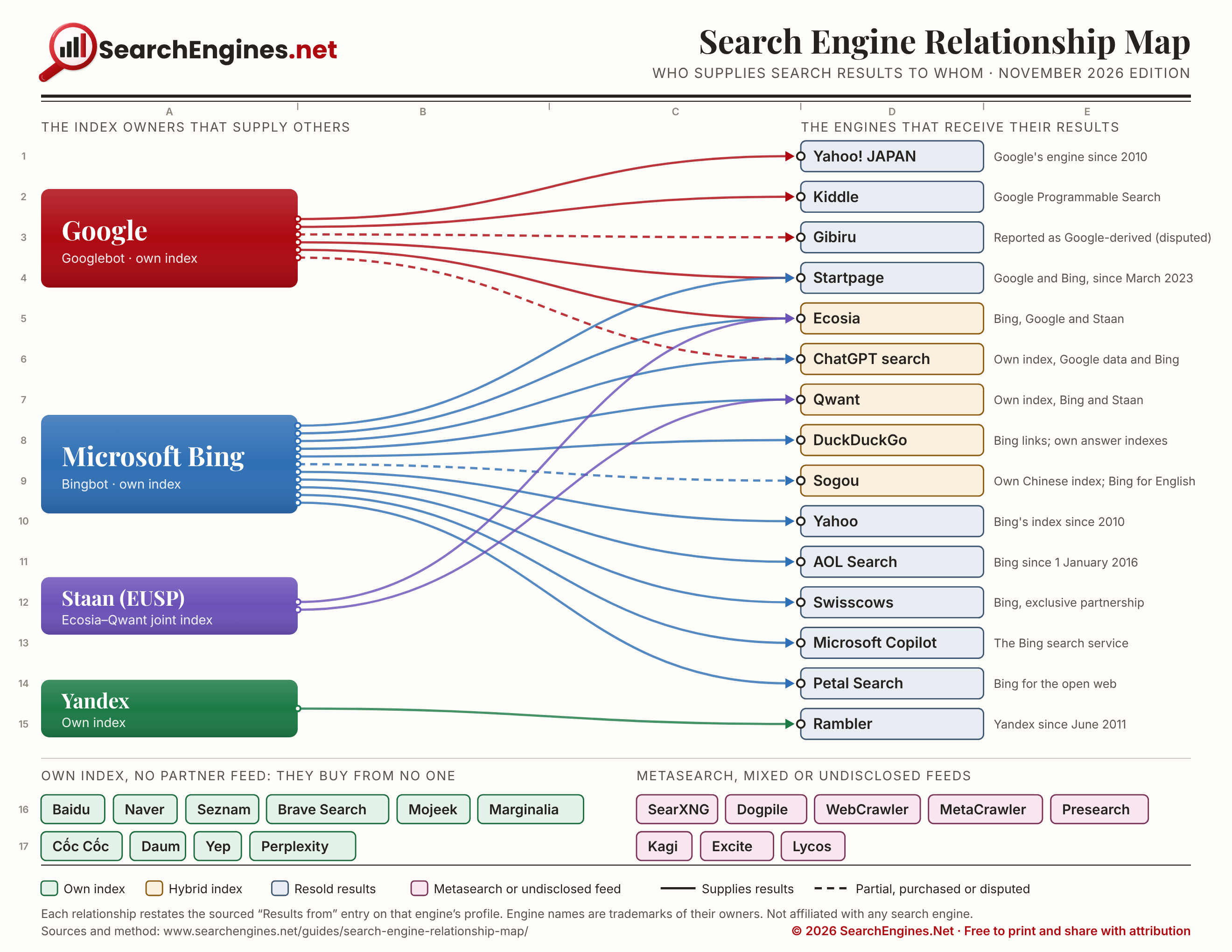
Search Engine Relationship Map
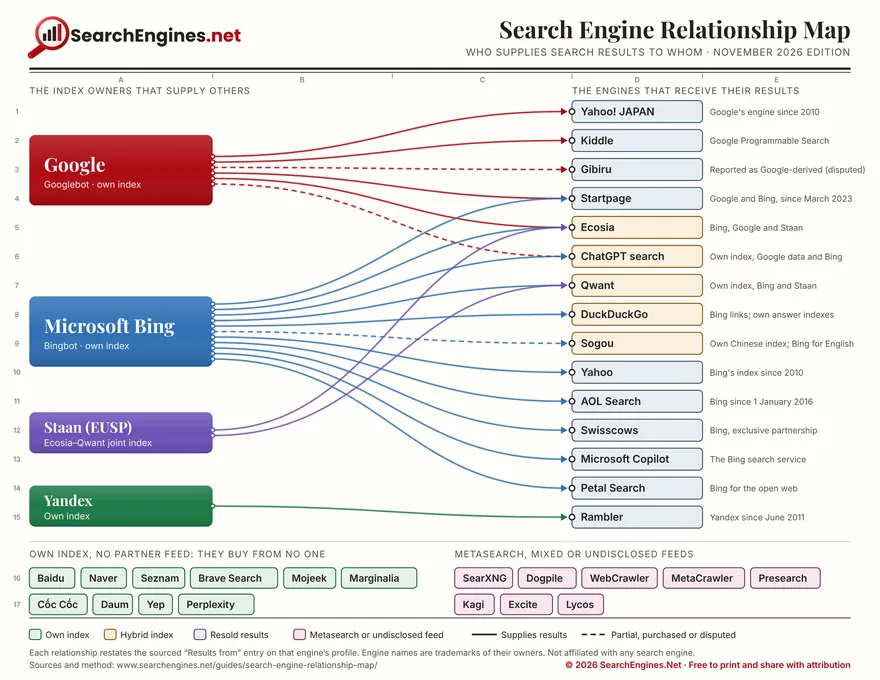
The search engine map covers 37 engines. Four index owners, Google, Microsoft Bing, Yandex and the European index Staan, supply web results to fifteen other engines, and Bing alone supplies eleven of them. Ten engines buy from no one, and eight more are metasearch engines or portals with mixed or undisclosed feeds. Each line restates a sourced fact from that engine's profile. The full explanation, the table of every relationship and the method are on the search engine relationship map page.
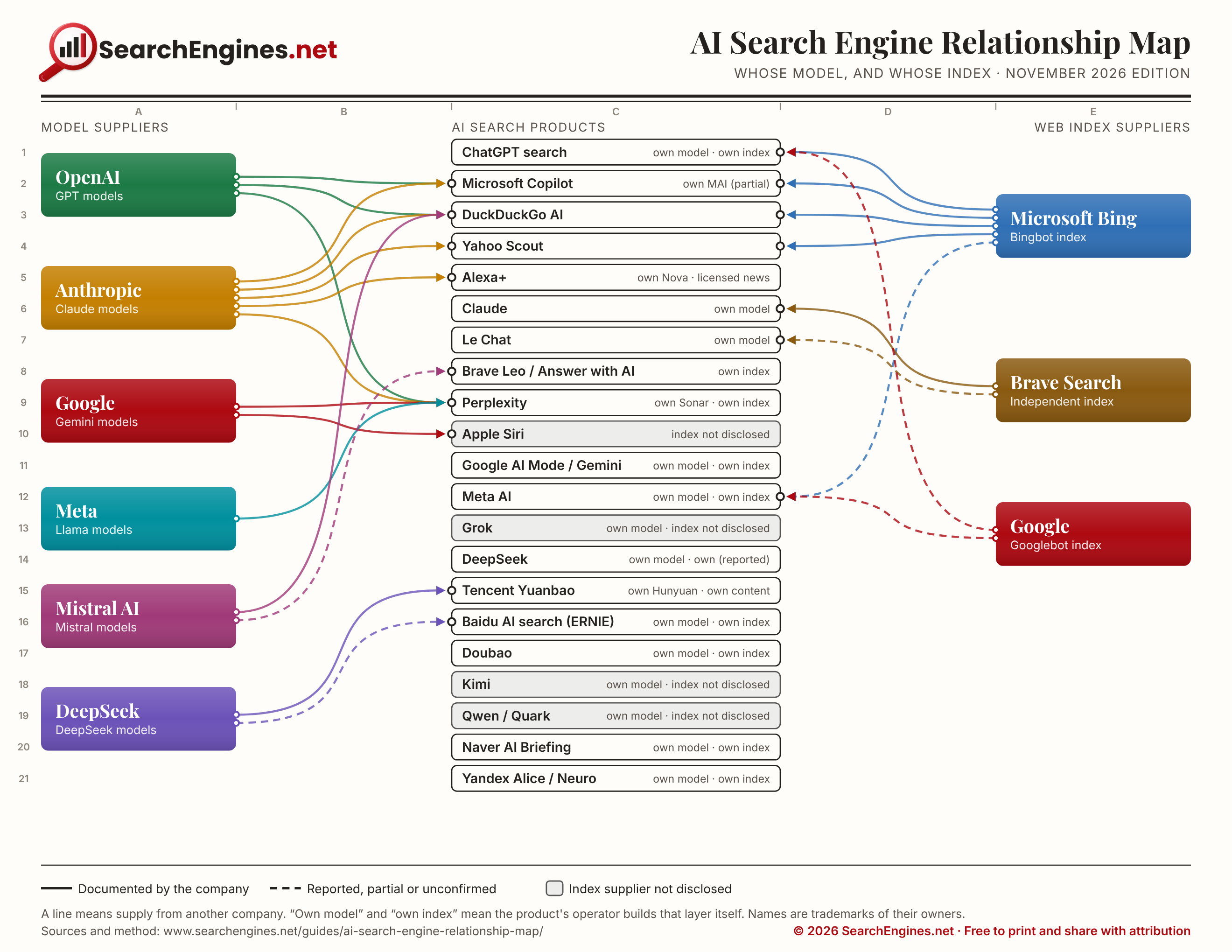
AI Search Engine Relationship Map
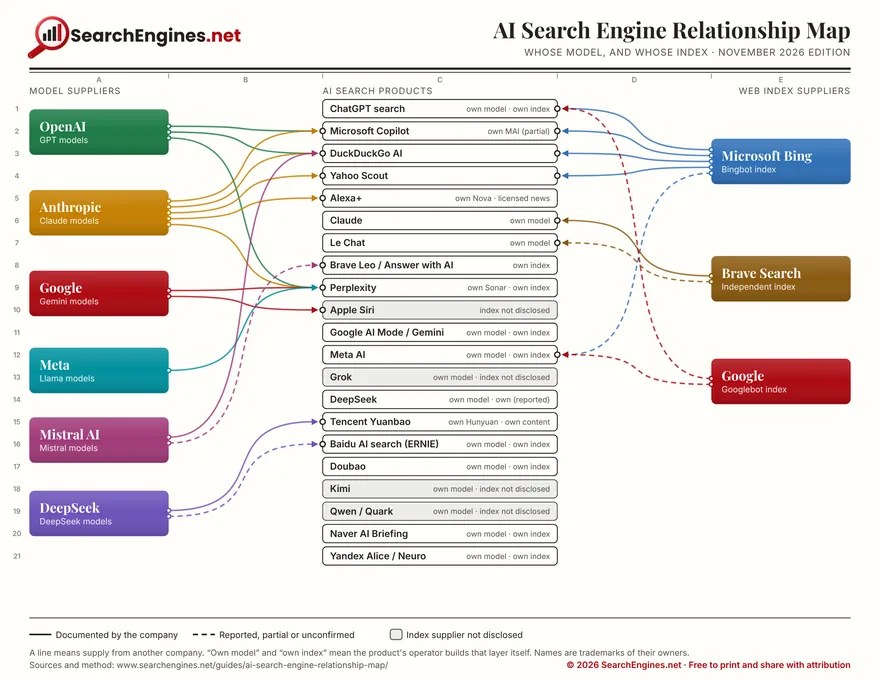
The AI map covers 21 AI search products worldwide and adds a second dimension, because an AI product needs a language model as well as a web index. Six model makers appear on the left, three index owners on the right, and the products sit between them. Solid lines are documented by the company concerned; dashed lines are reported; products whose index source is not disclosed are marked as such. The full explanation is on the AI search engine relationship map page, and four companion charts covering grounding, the full stack, crawlers and content licensing are on the AI search charts hub.
Which map answers which question
| Question | Map to use | What it covers |
|---|---|---|
| Whose results does Yahoo, DuckDuckGo or Startpage show? | Search Engine Relationship Map | 37 engines; one relationship, the web index |
| Which engines crawl the web themselves? | Search Engine Relationship Map | Ten engines that take no partner feed |
| Whose model and whose index does an AI assistant use? | AI Search Engine Relationship Map | 21 products; two relationships, model and index |
| Which AI companies do not say where their web results come from? | AI Search Engine Relationship Map | Products marked as not disclosed |
The two are designed to be read together. A market-share table counts brands; these diagrams count suppliers, and the number of suppliers is far smaller than the number of brands. Yahoo, for example, appears on both: its web links come from Microsoft Bing, and its Scout assistant pairs Bing with a model from Anthropic.
Download the maps
Search Engine Relationship Map
- Search Engine Relationship Map, PDF: one page, US Letter landscape, vector, with fonts embedded.
- Search Engine Relationship Map, PNG: 2,640 by 2,040 pixels.
AI Search Engine Relationship Map
- AI Search Engine Relationship Map, PDF: one page, US Letter landscape, vector, with fonts embedded.
- AI Search Engine Relationship Map, PNG: 2,640 by 2,040 pixels.
Both PDFs also print cleanly on A4. The maps may be printed, shared and reproduced without charge, provided the SearchEngines.net attribution and the edition date remain visible. These are the November 2026 editions, checked on 20 November 2026, and each is reissued when a relationship on it changes.
How to cite or link to the maps
Each map carries its edition month in the header, and a citation should include it, because the relationships change. A suitable form is: SearchEngines.net, Search Engine Relationship Map, November 2026 edition. When linking, point to this page or to the individual map page, not to the image file, so that readers reach the current edition and the sourcing behind it. The PDF addresses stay the same from one edition to the next; the PNG addresses include the edition and are replaced when a new one is issued.
Corrections are welcome. Every line rests on a cited source, and a supplier relationship that has changed is exactly the kind of error this site wants to hear about.
Frequently asked questions
What is a search engine relationship map?
A diagram showing which search engines supply results to which. Many well-known search brands do not crawl the web themselves and license results from a company that does, and the map draws those supply lines.
Are the maps free to use?
Yes. Both maps are free to print, share and reproduce, provided the SearchEngines.net attribution and the edition date on the map are kept.
What is the difference between the two maps?
The search engine map shows one relationship: whose web index an engine's results come from. The AI map shows two, because an AI search product needs a language model as well as a web index, and they often come from different companies.