- Edition
- November 2026
- Checked
- 20 November 2026
- Covers
- 37 search engines
- Formats
- PDF, PNG and this page
Four index owners supply most of the other search engines
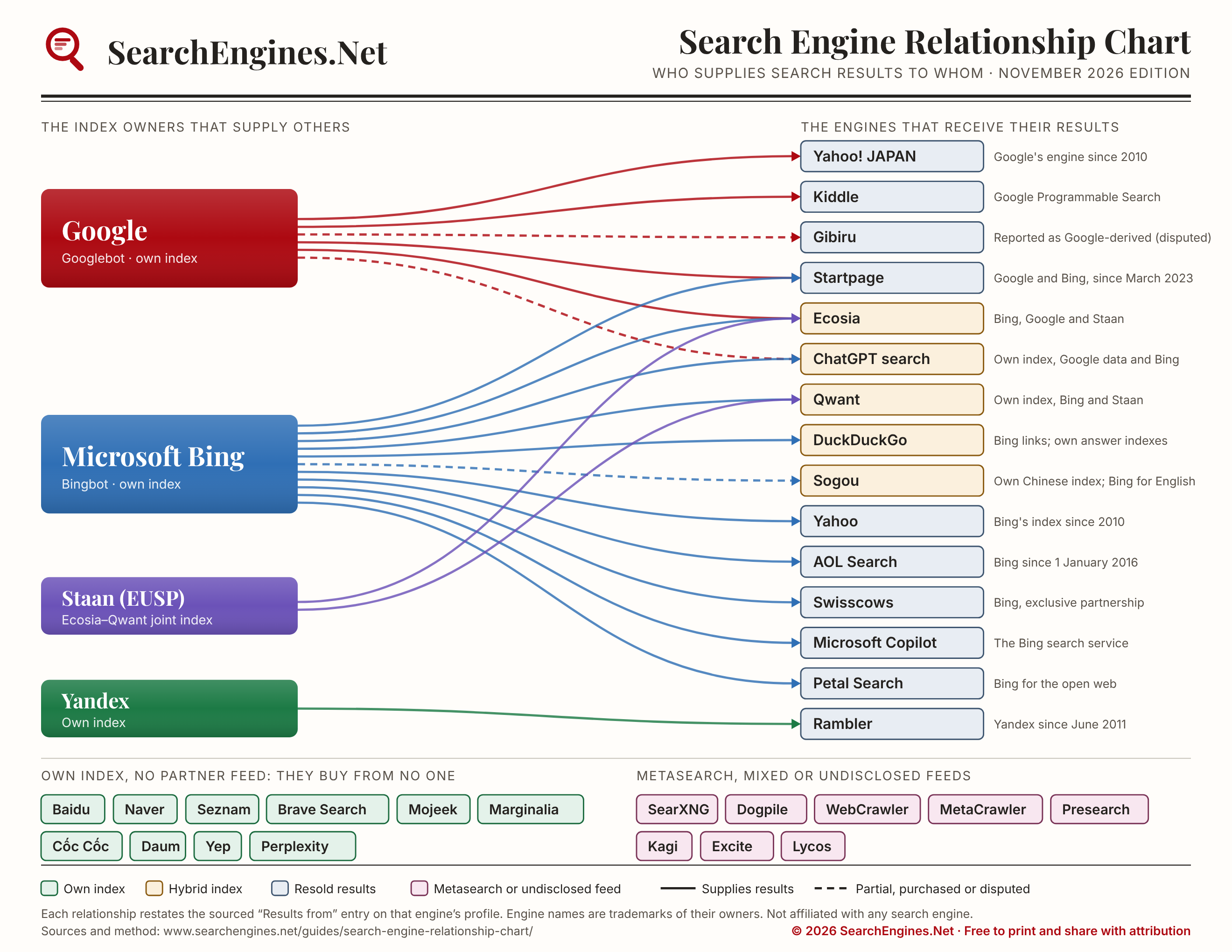
Most search engines do not find their own results. Of the engines on this chart, fifteen receive web results from one of four suppliers: Google, Microsoft Bing, Yandex and Staan, the index operated by European Search Perspective (EUSP), the joint venture of Ecosia and Qwant. Bing alone supplies eleven of them. The chart above draws each of those supply lines, and lists separately the ten engines that buy from no one and the eight whose feeds are mixed or undisclosed.
The chart answers one question: whose crawler found the page you are looking at? A crawler is the program that fetches web pages, and an index is the stored, searchable copy of what the crawler found. Building both at the scale of the web is expensive, which is why so few organizations do it and why so many well-known search brands license their results from someone who does.
How to read the chart
- Left column. The index owners that supply other engines. Each crawls the web itself and ranks what it finds.
- Right column. The engines that receive results. Blue-gray boxes resell a partner's results and run no web crawler of their own. Amber boxes are hybrids: they run a crawler or specialist databases of their own and blend in a partner's results.
- Solid lines. A results feed that the receiving engine itself names in its documentation, or that is recorded in a contract or regulatory filing.
- Dashed lines. A relationship that is partial, purchased or disputed. Sogou uses Bing for English-language queries only. OpenAI is reported to buy Google results data for ChatGPT search alongside its own crawl and Bing. Gibiru's results are widely reported to be Google-derived, which the profile on this site records as disputed.
- Bottom left. Engines that crawl for themselves and take no partner feed.
- Bottom right. Metasearch engines, which query several other engines at once, and portals whose supplier is undisclosed.
A line on this chart is a statement about web search results only. It says nothing about advertising, which is often supplied under the same contract, and nothing about ownership. Startpage is majority-owned by System1 and receives results from Google and Bing; those are separate facts.
Every relationship, as a table
The table carries the same information as the chart, with a link to the profile where each relationship is sourced.
| Engine | Type | Results supplied by | Detail |
|---|---|---|---|
| Yahoo! JAPAN | Resold results | Google's engine since 2010 | |
| Kiddle | Resold results | Google Programmable Search | |
| Gibiru | Resold results | Google (partial or disputed) | Reported as Google-derived (disputed) |
| Startpage | Resold results | Google, Microsoft Bing | Google and Bing, since March 2023 |
| Ecosia | Hybrid index | Google, Microsoft Bing, Staan (EUSP) | Bing, Google and Staan |
| ChatGPT search | Hybrid index | Google (partial or disputed), Microsoft Bing | Own index, Google data and Bing |
| Qwant | Hybrid index | Microsoft Bing, Staan (EUSP) | Own index, Bing and Staan |
| DuckDuckGo | Hybrid index | Microsoft Bing | Bing links; own answer indexes |
| Sogou | Hybrid index | Microsoft Bing (partial or disputed) | Own Chinese index; Bing for English |
| Yahoo | Resold results | Microsoft Bing | Bing's index since 2010 |
| AOL Search | Resold results | Microsoft Bing | Bing since 1 January 2016 |
| Swisscows | Resold results | Microsoft Bing | Bing, exclusive partnership |
| Microsoft Copilot | Resold results | Microsoft Bing | The Bing search service |
| Petal Search | Resold results | Microsoft Bing | Bing for the open web |
| Rambler | Resold results | Yandex | Yandex since June 2011 |
| SearXNG | Metasearch or undisclosed feed | Several | Up to 269 services per instance |
| Dogpile | Metasearch or undisclosed feed | Several | Names Google and Yahoo! |
| WebCrawler | Metasearch or undisclosed feed | Several | Undisclosed feeds |
| MetaCrawler | Metasearch or undisclosed feed | Several | Undisclosed feeds |
| Presearch | Metasearch or undisclosed feed | Several | Other engines, via nodes |
| Kagi | Metasearch or undisclosed feed | Several | Own indexes plus APIs |
| Excite | Metasearch or undisclosed feed | Several | System1 |
| Lycos | Metasearch or undisclosed feed | Several | Undisclosed partner |
| Baidu | Own index | None | Crawls and ranks its own index |
| Naver | Own index | None | Crawls and ranks its own index |
| Seznam | Own index | None | Crawls and ranks its own index |
| Brave Search | Own index | None | Crawls and ranks its own index |
| Mojeek | Own index | None | Crawls and ranks its own index |
| Marginalia | Own index | None | Crawls and ranks its own index |
| Cốc Cốc | Own index | None | Crawls and ranks its own index |
| Daum | Own index | None | Crawls and ranks its own index |
| Yep | Own index | None | Crawls and ranks its own index |
| Perplexity | Own index | None | Crawls and ranks its own index |
What the chart shows about the market
Bing is the wholesale index of the Western web
Microsoft Bing holds a small share of searches made directly on bing.com, but it is the supplier behind Yahoo, DuckDuckGo's web links, AOL Search, Swisscows, Petal Search, Microsoft Copilot and part of Startpage, Ecosia, Qwant and ChatGPT search. A measured share for any of those brands is, underneath, a measure of Microsoft's crawl in use. That is the reason a market-share table and this chart should be read together: the table counts brands, and the chart counts suppliers.
Google supplies few engines, and chooses them
Google's syndication is narrow: Startpage, Yahoo! JAPAN under an arrangement dating from 2010, and smaller services built on Google Programmable Search such as Kiddle. Whether that widens is an open legal question. The remedies ordered in United States v. Google LLC require Google to offer search syndication to qualified competitors; the judgment is on appeal, and no new syndication partner had been confirmed for this chart as of 20 November 2026.
Europe built a third supplier
Staan is the newest box in the left column. It began serving queries for Ecosia and Qwant in August 2025, and both engines continue to draw on Microsoft's index as well. It is the only supplier on the chart created specifically to reduce dependence on the other two.
Independence and size are unrelated
The engines in the bottom-left group range from Baidu, with hundreds of millions of users, to Marginalia, run by one engineer. What they share is that no line reaches them. Yahoo has far more measured share than Mojeek and crawls nothing; Mojeek has almost no measured share and crawls everything it serves.
Download, print and reuse
The chart is available in two print formats:
- Search Engine Relationship Chart, PDF: one page, US Letter landscape, vector, with fonts embedded. It also prints cleanly on A4.
- Search Engine Relationship Chart, PNG: 2,640 by 2,040 pixels, for slides and documents.
The chart may be printed, shared and reproduced without charge, provided the SearchEngines.Net attribution on it is kept and the edition date remains visible. The edition date matters because these relationships change: Yahoo has taken its results from Yahoo's own crawler, from Google, and from Bing at different points in its history, and Startpage added a second supplier in 2023.
Method, and when this chart was last checked
Each relationship restates the “Results from” entry on that engine's profile on this site, and each profile cites the engine's own documentation, a contract disclosure, a court record or a regulator's finding. Where an engine does not disclose its supplier, the chart says so and draws no line. No relationship is inferred from the appearance of a results page.
This is the November 2026 edition, checked on 20 November 2026. One change since the profiles were last revised is reflected in the notes: Yahoo's rebuilt search page, announced on 10 November 2026 as Pivot Search, adds an AI answer layer and does not change where Yahoo's web results come from. Engines that have closed, including Ask.com, which shut down on 1 May 2026, are not shown. The chart will be reissued when a relationship on it changes.
Frequently asked questions
Which search engines use Bing's results?
Yahoo, AOL Search, Swisscows, Petal Search and Microsoft Copilot take their web results from Microsoft Bing. DuckDuckGo takes its web links largely from Bing alongside its own answer indexes, and Startpage, Ecosia, Qwant and ChatGPT search use Bing as one of several sources. Sogou uses Bing for English-language queries.
Which search engines use Google's results?
Startpage, which also uses a second supplier; Yahoo! JAPAN, which has used Google's search engine since 2010; Ecosia, alongside Bing and the Staan index; and services built on Google Programmable Search, such as Kiddle. ChatGPT search is reported to draw on purchased Google results data alongside OpenAI's own index and Bing.
Which search engines have their own index?
Google, Microsoft Bing, Yandex, Baidu, Naver, Seznam, Brave Search, Mojeek, Marginalia, Cốc Cốc, Daum, Yep and Perplexity each crawl the web and rank their own index. Qwant, Kagi, DuckDuckGo, Sogou, Ecosia and ChatGPT search are hybrids that combine crawling of their own with a partner's results.
Is DuckDuckGo powered by Bing?
Largely, for web links. Its traditional web results come mostly from Microsoft's index, and DuckDuckGo adds its own crawler and its own data for instant answers and other features. This site classes it as a hybrid for that reason.
Can I print or republish the search engine relationship chart?
Yes. The PDF and PNG are free to print, share and reproduce, provided the SearchEngines.Net attribution and the edition date on the chart are kept.
How often is the chart updated?
When a relationship on it changes. Each edition carries its month and year in the header, and the date it was last checked is given on this page. The current edition is November 2026.